

Interview: Ilan Eshkeri Talks Space Station Earth and How Tim Peake Inspired the Project
 Write a comment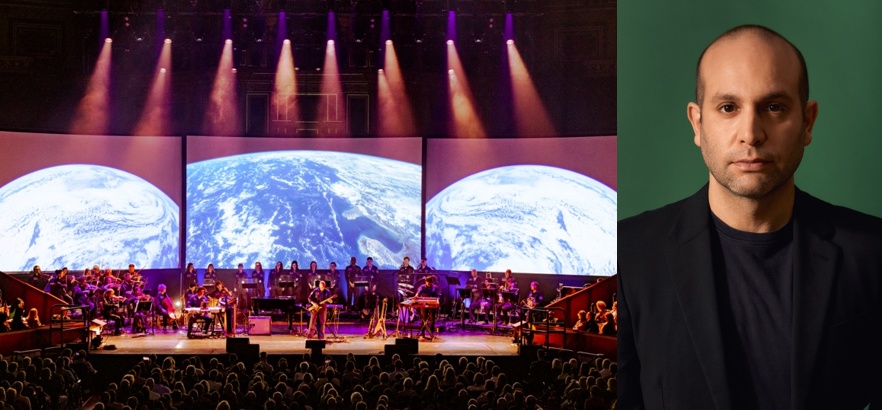
Composer Ilan Eshkeri is set to tour the UK this summer with Space Station Earth, a powerful live work shaped by real footage filmed aboard the International Space Station and inspired by conversations with astronauts, including British ESA astronaut Tim Peake.
First premiering to a sold-out Royal Albert Hall in 2022, the project explores the profound shift in perception known as the Overview Effect, the experience of seeing Earth from space as a single, fragile system. Ahead of the tour, Eshkeri spoke to us about how meeting Tim Peake sparked the idea, blending music with spaceflight imagery, and what he hopes audiences take away from this immersive experience.
Hi Ilan, thanks for talking to us. You are taking Space Station Earth on tour this summer. When did you come up with the idea to create this musical experience?
The inspiration for the project began with meeting Tim Peake, who reached out because he was a fan of my work. That conversation opened a wider exchange with astronauts and led to time spent at NASA and ESA. What emerged from those encounters was not a single idea, but a growing awareness of how profoundly seeing Earth from space alters perception. To see through the eyes of an astronaut is to encounter the planet as a whole, finite, intricate, and constantly in motion. Space Station Earth developed as a way of exploring that shift through music, allowing it to be experienced over time rather than explained.
The show combines footage filmed by astronauts from the International Space Station. How did this come about?
The film was written and directed by me as an accompaniment to the music and developed as part of the same compositional process. Sound remains the primary narrative force, with the film unfolding alongside it so that meaning is discovered through their interaction. The work is performed by a synthesiser band alongside orchestra and choir, framed by three large screens forming the triptych film. The images are primarily footage filmed aboard the International Space Station, functioning as layers within the work rather than visual narration. Together, sound and image move between vast scale and fragile detail, creating an environment in which the audience is invited to join the crew, not as observers, but as participants within a shared system.
You have scored music for films like Layer Cake and Stardust. When and how did you get your first breakthrough?
Layer Cake was an important early point because it allowed me to bring together rock guitar, synthesisers, and orchestra within a single musical language. That reflected how I was already thinking about composition, using texture, rhythm, and harmony to shape emotional trajectories over time. Stardust built on that same approach. Writing themes based on the illustrated novel and working within its fantasy adventure world gave me the opportunity to explore those ideas at a larger orchestral scale and to collaborate with the filmmakers on the arc of the emotional narrative. The fact that these films have endured as cult classics helped establish a way of working where different processes affect each other and combine to form a coherent whole.
What inspiration do you seek when creating scores?
I’m drawn to art and science that resist simple interpretation. This connects closely with my compositional practice, which is built from repeating melodic material that changes gradually through harmonic layering and rhythmic variation, allowing emotional states or trajectories to develop without meaning being imposed. Synaesthesia plays an important role in that process. Sound and colour are linked for me, so visual art, light, and spatial ideas often shape how music takes form. When I’m composing, I often avoid listening to music altogether and instead draw on literature, visual art, or ideas from physics as parallel sources of inspiration.
Which artists do you listen to in your spare time?
I don’t really separate listening into work and spare time in a strict way. I tend to move between different forms, it might be music, but it could just as easily come from the art world, fashion, film, performance, or a novel or a science paper. I’m interested in how ideas can cross pollinate between disciplines.
If you could collaborate with any artist, who would it be and why?
Collaboration grows out of circumstances rather than a plan to work with a particular person. I’m interested in situations where different ways of working naturally come together across a variety of disciplines. Each element helps shape the overall experience. When it works, as with all strong creative moments, it feels like something coherent forming on its own.
What do you want people to take away from the live experience of Space Station Earth?
One of the things astronauts often describe is that no two people return with exactly the same emphasis after seeing Earth from space. I think the same is true of this work. Space Station Earth is designed as an experience rather than a statement, and different audiences will connect with different aspects of it, such as scale, fragility, motion, and intimacy. The live performance moves between those states, allowing each person to find their own way through it. The idea of Earth as a shared system sits quietly beneath the experience, but what stays with an individual afterwards is unique to them.
What would you like to achieve by the end of 2026?
I don’t love the creative outcomes as much as I love the creative process. If, by the end of 2026, I’m still curious, still experimenting, and still finding new ways for my work to evolve, I will be content.


Log in with
or post as a guest
Be the first to comment.