

Bjørn talks about Music in Space, his extraordinary journey around the world and his new single "Rockstar", out now
 Write a comment
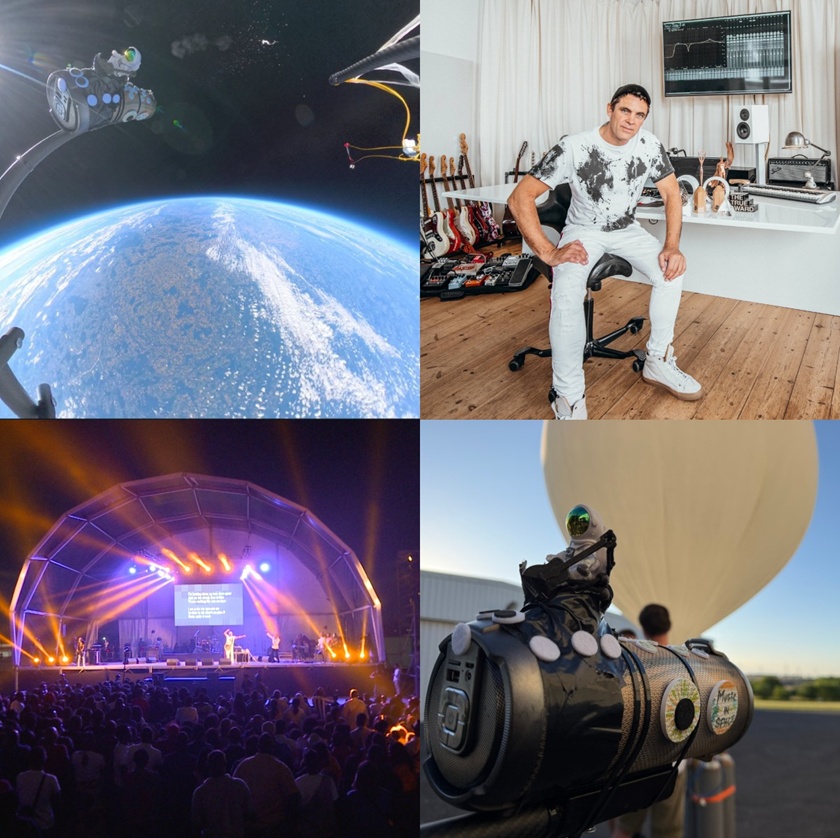
After five and a half years travelling through 84 countries with a portable recording studio, Danish musician and filmmaker Bjørn has built something far bigger than a music project. Music in Space brings together artists from across the globe, blending amapiano, Afropop and rock while using music to explore our relationship with the planet.
From recording with musicians across Africa to sending his music 37,250 metres into the stratosphere, Bjørn’s extraordinary journey is driven by creativity, collaboration and a powerful environmental message. We caught up with him to discuss the adventure, the project’s latest single, "Rockstar", and what comes next.
Hi Bjørn, thanks for talking to us.
You have spent five and a half years travelling through 84 countries with a portable recording studio, working with musicians in different countries and cultures. Where did the idea for Music in Space begin, and did you have a clear vision of what it might become?
It started with penguins. I played a concert for them at the South Pole. Afterwards a CNN journalist joked that the next one should be in space. I laughed, but the idea stuck. So I sold everything and went on the road with a guitar and a portable studio. There was no master plan. I knew I wanted to make music with people, and to say something about the planet we share. The rest found me along the way.
You have lived and worked in Africa from a very young age, and previously spent around ten years touring the world with Danish punk band Dansk Fløde. How have those experiences shaped the way you approach music, collaboration and working with artists from different backgrounds?
I've been travelling and working in Africa since I was one year old, so it never felt foreign. It felt like home. Ten years on the road with Dansk Fløde taught me the other half: how to play anywhere, for anyone, with whatever works that night. Put those together and you stop thinking in borders. You just ask: who's in the room, and what can we make together?
Music in Space brings together artists from 22 countries, mixing amapiano, Afropop and rock. How did you arrive at this particular musical identity, and what happens creatively when musicians with such different influences come together?
I didn't design it. It happened. African grooves and wild electric guitar have fed each other for decades, from the blues onwards. When I sat down with musicians in Kampala, Johannesburg or Cape Maclear, the amapiano and Afropop came from them and the burning guitar came from me. Nobody gives up who they are. Each culture makes the other better. That's the sound.
Your new single, "Rockstar", features four guest singers from South Africa, Uganda, Rwanda and Malawi, alongside your own musical contribution. How did you bring everyone together around the same song, and what was the brief you gave each vocalist?
Every singer got the same brief: sing about the world we live in, how it is changing, and how we choose to live in it. That's all. No rules about style or language. Zee Nxumalo in South Africa, Bowman Aremwaki in Uganda, Kenny Sol in Rwanda, Zeze Kingston in Malawi. Same question, five completely different answers. That's the beauty of it. One song, heard through five lives.
The song has an interesting dual meaning. On one level, it challenges the way we consume the planet's resources, but it also suggests that every individual has the power to shape the future through their choices. When did those two ideas come together?
From the start. "Rockstar" isn't about being famous. Right now we all behave like rockstars, as if we can treat the planet however we like and the party never ends. The chorus answers that: "We can't go on like this." But you're also the rockstar in your own life. You have the right to decide. Every choice you make shapes what comes next. The wake-up call and the power to act are the same song.
You have described the project as a way of getting the climate question onto people's lips without being preachy. How important is it to you that music can communicate serious ideas while still being uplifting, entertaining and enjoyable?
It's everything. Nobody changes because someone points a finger at them. My mother used to say, "If you have the ability, you have the duty." I have music, so that's my tool. I'd rather talk about pollution, in the air, in our bodies and on Mother Earth, than about abstract climate change. And I'd rather people dance and then talk about it at the dinner table. A little change from everyone adds up to a lot.
The journey behind Rockstar has taken you from recording sessions in Kampala to Nyege Nyege Festival, Amahoro Stadium in Kigali and festival stages in Malawi and Mozambique. Is there a particular encounter or moment along the way that changed the way you thought about the project?
Cape Maclear in Malawi. We rented the main square for three days for 100 dollars and put on a climate festival. Around ten thousand people came. Local dancers, Zeze Kingston, Sir Kisoro from Uganda, kids everywhere. Standing there on the shore of the lake, I fell in love with the Earth all over again. That's when I knew this wasn't a band project. It was a mission.
In August 2026, you took the music to an extraordinary height, sending it 37,250 metres into the stratosphere on a weather balloon equipped with a loudspeaker and camera. What inspired you to take music into the stratosphere, and what did you hope to achieve with the experiment?
The penguin joke came true. In August 2026 we sent a weather balloon up with a loudspeaker playing our music and a camera filming it. It reached 37,250 metres before the balloon burst. It's a serious trick. People stop and ask, "You did what?" And then we get to talk about the planet. From up there you see one thin blue line holding everything alive. That's the picture I want people to carry home.
You are also a filmmaker and sound designer, trained at the National Film School of Denmark, and are multi-award-winning. How does your background in film influence the way you develop Music in Space, particularly its visual identity and storytelling?
I'm a filmmaker first. I trained at the National Film School of Denmark, and I think in pictures. Every song has a film behind it, shot across the planet over five years. On stage, the band plays in front of big screens where the artists from around the world join in. The aim of the visuals is simple: to make you fall in love with our planet again.
The project seems to be as much about human connection as it is about music. Having worked with so many artists across different countries and cultures, what have you discovered about the things that connect us, regardless of language or background?
Rhythm, food and laughter. You don't need a shared language to groove together. I've jammed with people I couldn't say ten words to, and an hour later we were friends. Musicians are the same everywhere. They want to play, be heard and be treated fairly. Give them that, and borders disappear.
A feature documentary about the journey is planned for 2027, alongside the Music in Space Tour 2027. How will the documentary expand on the story behind the music, and what can audiences expect from the live experience?
The film tells the whole journey: the friendships, the setbacks, the stadiums and the villages, and the balloon. It also includes voices like Jane Fonda, astronaut Andreas Mogensen and climate scientist Peter Ditlevsen. It follows in 2027. The live show is the Music in Space Tour 2027. It scales from me and a percussionist up to a full band with dancers, cello, choir and big screens. At the bigger shows we can even launch a balloon with the audience.
Finally, when people listen to Rockstar or experience Music in Space, what would you most like them to take away with them? And looking ahead, what would you love to see this project become?
That they're the rockstar in their own life. Small choices matter. If eight billion people change a little, that's a lot. Looking ahead, I'd love Music in Space to become the world's biggest environmental band. That sounds big, I know. But we started from nothing, and look where the music has already been.


Log in with
or post as a guest
Be the first to comment.